Our Blog
Chapter 3: The Six Stages of Resistance-When Operators Fight Back
If you've ever rolled out a new system and watched teams nod in the meeting room-then ignore it completely on-site, you've witnessed what we call the resistance curve.
In Chapter 2, we covered how digitalization stops pilferage, misrepresentation, and waste. But here's the reality no vendor talks about: the moment you start monitoring, people start adapting. And if you can't read their moves, you'll lose.
Welcome to the behavioral battlefield.
Teams that pair operator monitoring with a fuel monitoring solution catch these shifts earlier and investigate them with evidence.
The Six Stages of Resistance: A Playbook of Pilferage
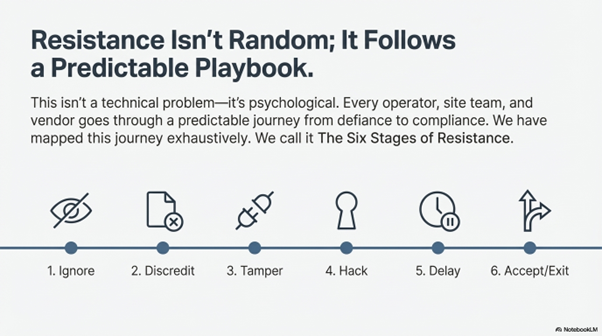
Digitalization isn't technical-it's psychological. Every operator, every site team, every vendor goes through a predictable journey from defiance to compliance. We've mapped it exhaustively. Here's what it looks like:
Stage 1: Ignore
"Business as usual. The sensors are just for show."
Draining is rampant and blatant. Operators siphon fuel during refueling, assuming no one will check. They're right-most don't.
Stage 2: Discredit
"Your data is wrong. The sensor is faulty."
Alerts start landing. Data is aggressively challenged. Operators claim false positives, blame calibration, or cite "technical errors." Without field verification, this is where most digitalization projects die.
Stage 3: Tamper
"If we can't hide the theft, we'll hide the device."
Devices are unplugged, SIM cards removed, or antennas blocked. Reporting drops to 60%. The system looks broken, and frustrated managers pull the plug.
Stage 4: Hack
"Okay, they're watching. Let's get smarter."
Operators drain smaller quantities-just 5-10 liters-while the engine runs, hiding theft within normal operational variance. This is precision pilferage.
Stage 5: Delay
"Keep assets offline to salvage what we can."
Vehicles are marked "under maintenance" or "not in use" to buy time, allowing final undetected draining before full compliance is forced.
Stage 6: Accept/Exit
"I guess this is the new normal."
Operators either adapt to the transparent system-or self-select out. Both outcomes are wins.
The Draining Taxonomy: Reading Behavioral Fingerprints
Here's the crucial insight: each resistance stage leaves a unique data signature. We don't just flag theft; we classify how it's happening, which tells us exactly where an operator is in the resistance journey.
R&D Draining (Refueling & Reallocation)
Signature: Large, sudden drops during or immediately after refueling events.
Stage: Ignore - early, blatant theft. Easy to catch if you're looking.
Manual Draining
Signature: Small, frequent withdrawals during operational cycles, often masked as idle consumption.
Stage: Hack - operators think they've outsmarted automation. We catch this only through meticulous manual audits and cross-verification with engine load data.
Return Pipe Draining
Signature: Fuel bypasses the sensor by being redirected from the return line into jerry cans mid-operation. No drop is registered, but consumption spikes disproportionately to work done.
Stage: Tamper/Hack - this is advanced evasion, requiring physical inspection and hardware hardening to defeat.
Suspicious Draining
Signature: Consumption patterns defy all operational logic-high burn with zero productivity, or fuel disappearing without any detectable event.
Stage: Any - this is the catch-all for anomalies that require further human verification. It signals gaps in our understanding and prompts deeper investigation.
Planned Draining
Signature: Pre-communicated fuel removal by the client's own P&M team for testing, maintenance, or transfers.
Stage: N/A - this isn't resistance; it's operational necessity. We whitelist these events to avoid false positives and maintain trust with site teams.
Why This Matters: From Passive Data to Active Intelligence
Here's the difference between digitization and digitalization in one sentence:
Digitization tells you fuel is missing. Digitalization tells you how it's being stolen, why the operator thinks they can get away with it, and what you need to do next.
These draining types aren't just labels-they're behavioral diagnostics. When we see a spike in Return Pipe Draining, we know we've hit Stage 3 and need to deploy tamper-proof kits immediately. When Manual Draining appears, we know we've reached Stage 4 and must escalate audits.
The system doesn't just collect data; it reads resistance and adapts faster than the operator can.
The Bottom Line
Technology alone fails because it's static. People are dynamic. Digitalization wins because it's a living process that evolves with the behavioral playbook of resistance.
For a practical companion piece, read Guarding Your Fuel.
Want a quantified example of the same controls? Read The Hidden Drain on EPC Profits. Want to see our resistance map in action? Schedule a demo and we'll walk you through real case data.